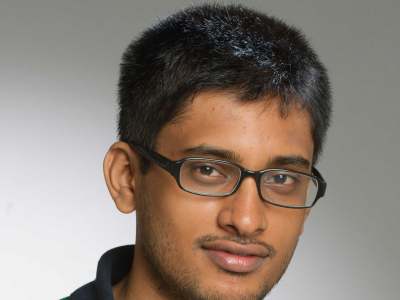
-
Biosketch
Education
- PhD, Mathematical Sciences, Georg-August-Universität Göttingen (Jointly with the group of Biomed NMR, Max-Planck Institute for Biophysical Chemistry (Now Multidisciplinary Sciences)), Göttingen, Germany.
- M.Tech, Mechanical Engineering, IIT Kanpur, Kanpur, Uttar Pradesh, India.
- B.M.E, Mechanical Engineering, Jadavpur University, Kolkata, India.
Experience:
- February 2023 - Present: Ramanujan Faculty Fellow, IIT Palakkad, India.
- September, 2022 - February, 2023: Assistant Professor, Department of Mechanical Engineering, GITAM University, Visakhapatanam, India.
- May, 2021 - April, 2022 : Postdoctoral Fellow, Universidad del País Vasco (University of Basque Country, UPV/EHU), Leioa, Basque Country, Spain.
- February, 2020 - March, 2021 : Postdoctoral Fellow, Basque Center for Applied Mathematics (BCAM), Bilbao, Spain.
- January, 2018 - January, 2020: Postdoctoral Scholar, Centre for Applicable Mathematics, TIFR, Bengaluru, India.
-
Research
My current research centers on inverse problems governed by partial differential equations, with a particular focus on thermo-fluid systems. I use physics-informed machine learning methods to address these challenges, with a focus so far on accurate parameter estimation in complex thermo-fluid systems using sparse and noisy measurements. These studies provide the foundation for my ongoing and future work on real-time thermal monitoring and the development of digital twins for complex thermo-fluid systems. I have also applied similar ideas to subsurface characterization in geophysical contexts. In some of these applications, I adopt a Bayesian framework for parameter estimation, which allows for explicit quantification of uncertainty arising from noise and limited data.
Although my current research focuses on inverse problems and data-driven approaches, my primary training is in numerical modeling, the development of high-order numerical schemes, large-scale simulation, and high-performance scientific computing. I have worked on several complex systems, including flow MRI, computational electrodynamics, and magnetohydrodynamics. This background has shaped my interest in developing highly accurate and stable numerical methods for obtaining high-fidelity solutions to a broad range of complex science and engineering problems. -
Teaching
August - December, 2025:
- ME 3050A Heat and Mass Transfer
August - December, 2023, 2024:
- ME 5614 Computational Fluid Dynamics
January - May, 2024, 2026:
-
ME 5632 Computational Methods for Inverse Problems in Science and Engineering
August - December, 2023:
-
ME 1130 Engineering Drawing, IIT Palakkad, 2023 (Co-teacher)
-
Research Group
- MS -- Pradipan Maitra (Jul 2024– Sep 2026), Mechanical Engineering (Thesis submitted).
- PhD -- Arjun K S, Mechanical Engineering, 2026- (jointly with Prof. Anand TNC)
- Postdoctoral Fellow -- Abhishek Shrivastava (Feb 2026– ), PhD (Mechanical Engineering, IIT Delhi)
- Project Associate -- Jariful Hassan (Nov 2025– April 2026), M.Sc Mathematics, South Asian University
-
Additional Information
TitleSelected PublicationsDescription
A. Hazra, P. Sarkar, and S. Sarkar, “PINN-based Estimation of Convective Heat Transfer in Jet Impingement Cooling”. (Accepted in Appl. Therm. Eng., 2025)
Arijit Hazra, Dinshaw S. Balsara, Praveen Chandrashekar, Sudip K. Garain. Multidimensional generalized Riemann problem solver for Maxwell’s equations, (Accepted in J. Sci. Comp., 2023)M. Shahriari, A. Hazra, D. Pardo. A deep learning approach to design a borehole instrument for geosteering, Geophysics (2022),87(2): D83
R. Käppeli, D. S. Balsara, C. Praveen, A. Hazra. Optimal, globally constraint-preserving, DG(TD)2 schemes for computational electrodynamics based on two-derivative Runge-Kutta timestepping and multidimensional generalized Riemann problem solvers- a von Neumann stability analysis, J. Comput. Phys., 408, 109238
A. Hazra, C. Praveen, D.S. Balsara, Globally constraint-preserving FR/DG scheme for Maxwell’s equations at all orders, J. Comput. Phys., 394, 298-328
A. Hazra, G. Lube, H. Raumer, Numerical simulation of Bloch equations for dynamic magnetic resonance imaging, Appl. Numer. Math., 123, 241-255